
The Expanding Fraud Stack Across Compute Eras
Each new era of computing amplifies existing fraud operations while simultaneously introducing new attack techniques inside the same underlying fraud lifecycle.
That observation may be one of the most important ways to understand modern fraud evolution.
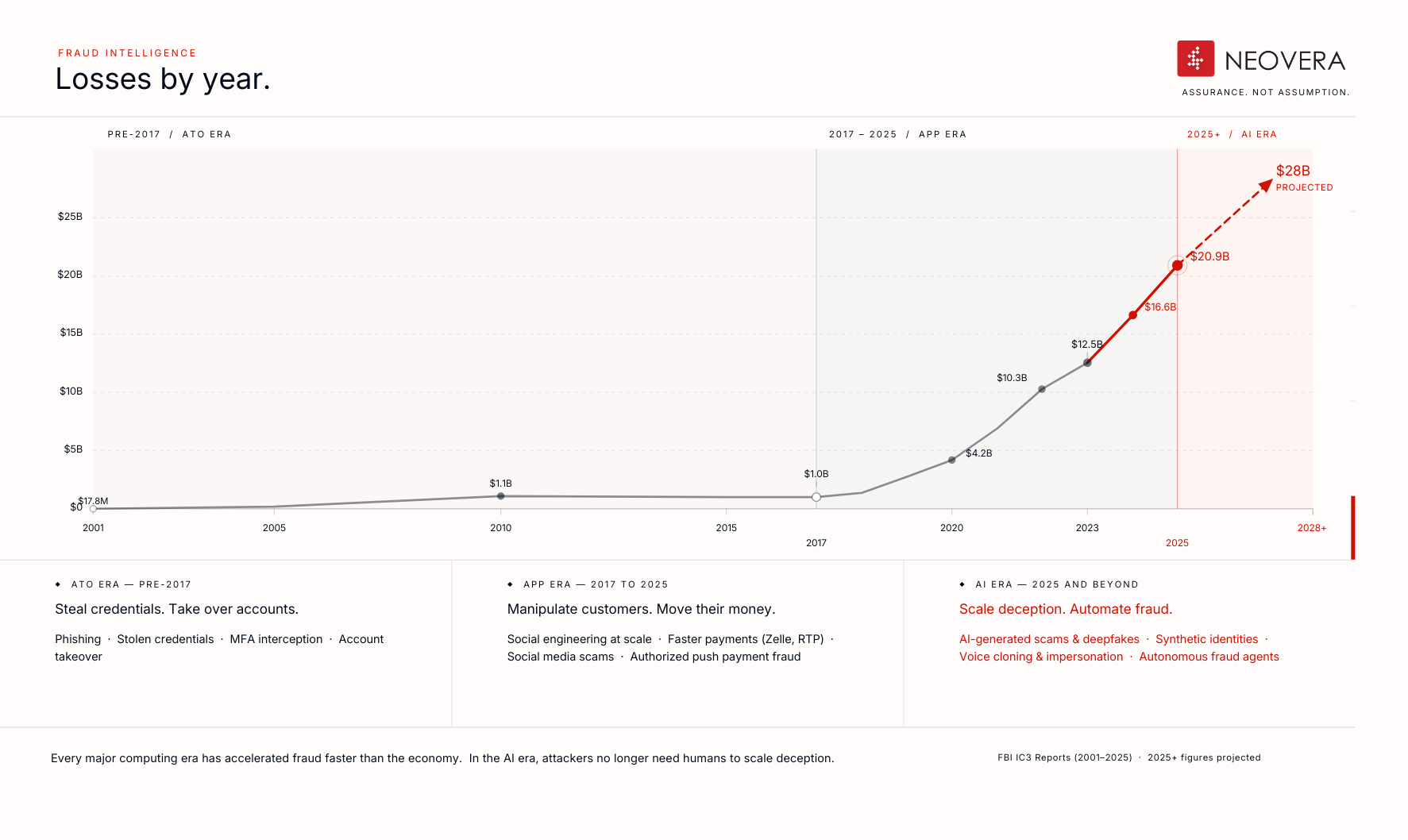
Old fraud techniques rarely disappear. Instead, each new computing era amplifies existing fraud operations by increasing attacker scale, speed, coordination, personalization, and operational efficiency while also introducing entirely new techniques inside the same underlying fraud lifecycle.
As shown in the infographic below, most fraud operations still follow three familiar stages:
- Preparation and access
- Fraud execution
- Monetization and funds dispersion
What changes across computing eras is not the existence of these stages. What changes is how technology amplifies them.
Historically, fraud preparation involved physical theft, stolen mail, counterfeit documents, and in-person recruitment of accomplices. The internet introduced phishing, malware, credential theft, and dark web marketplaces. Mobile and social platforms accelerated romance scams, mule recruitment, real-time coordination, and mobile-enabled fraud.
Now AI is amplifying this stage again through deepfake impersonation, AI-generated phishing, synthetic identities, voice cloning, and automated scam conversations.
The same pattern appears during fraud execution. Account takeover, check fraud, wire fraud, and impersonation scams are not new concepts. However, digital banking, mobile devices, faster payments, and AI-assisted social engineering have dramatically increased attacker efficiency and reduced operational friction.
The monetization layer has evolved as well. What once relied on physical cash-outs and local mule networks now includes real-time payments, crypto-enabled laundering, globally coordinated mule activity, claims fraud, and increasingly automated dispersion techniques.
The key point is that fraud itself is not resetting with each compute era. It is compounding.
At Neovera, we increasingly view this through the lens of attacker economics. Every major computing era improves criminal operational efficiency:
- The internet increased scale
- Mobile and social improved reach and coordination
- AI introduces automation and personalization at unprecedented levels
That matters because modern fraud increasingly targets trust itself. Traditional security models focused heavily on validating identity and controlling access. But many modern fraud schemes bypass those controls by convincing legitimate users to authorize the activity themselves.
Organizations are no longer asking only: “Is this the right user?”
They are increasingly asking:
- Is the activity legitimate?
- Is the intent authentic?
- Is trust itself being manipulated?
Those are much harder operational questions to answer. Customers are increasingly asking similar questions themselves: Is this text message really from my bank? Is this voice actually my banker? Or is it an AI-generated agent that sounds exactly like them?
The organizations that adapt successfully will likely not be the ones chasing every new fraud headline. They will be the ones continuously validating whether their controls, workflows, and trust models still hold up as attacker capabilities evolve.
Because fraud does not reset with each new compute era. It expands.